

CFD-Validated Emergency Ventilation for a Battery Storage Container
A CFD-based ventilation assessment for a high-density battery storage enclosure, focused on airflow distribution and flammable-gas removal during a simulated battery-failure condition.
Emergency ventilation for a high-density battery enclosure
The project involved the ventilation assessment of a 40-ft battery storage enclosure containing 28 densely arranged battery racks and more than 24,000 individual battery cells.
The main engineering challenge was to evaluate how an emergency ventilation system could control flammable-gas accumulation during an abnormal battery-failure event.
CFD was used to assess how effectively fresh air could move through the rack-filled enclosure and support removal of released gases.
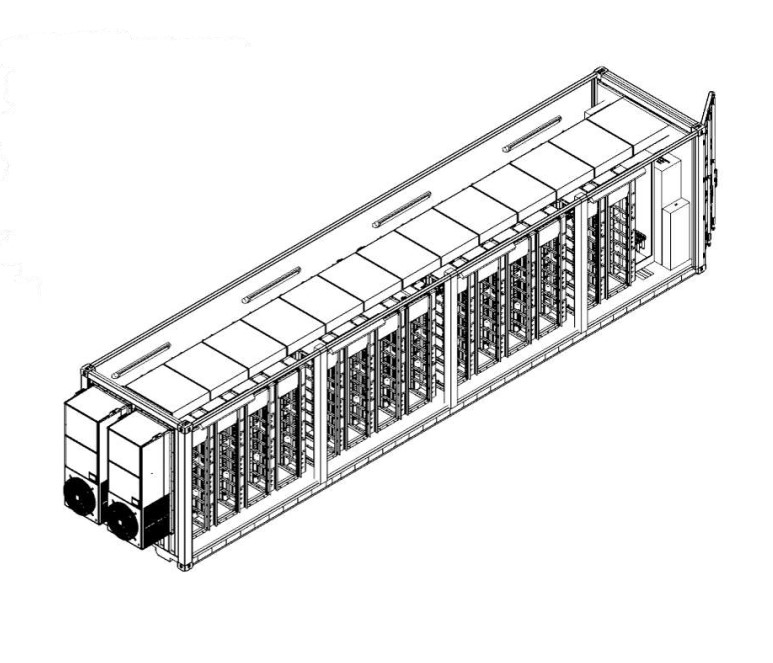
Using CFD to evaluate airflow and gas removal
The emergency ventilation concept used opposing supply and exhaust locations to promote airflow through the battery enclosure.
A transient CFD model was then used to assess the performance of the ventilation strategy under the simulated failure condition.
Airflow Distribution
Air movement through the battery rack arrangement was evaluated to identify circulation and potential stagnant regions.
Pressure Behavior
Internal pressure patterns were reviewed to assess how effectively the exhaust-driven ventilation system controlled airflow.
Gas Dispersion
Hydrogen transport and removal were evaluated throughout the enclosure during emergency ventilation operation.
Effective gas removal under the simulated condition
The CFD results demonstrated effective cross-ventilation through the enclosure and showed that the emergency ventilation system could clear the simulated hydrogen release under the assessed operating condition.
The analysis also provided a spatial view of gas concentration throughout the enclosure, helping verify that gas removal was not limited to a single local region.
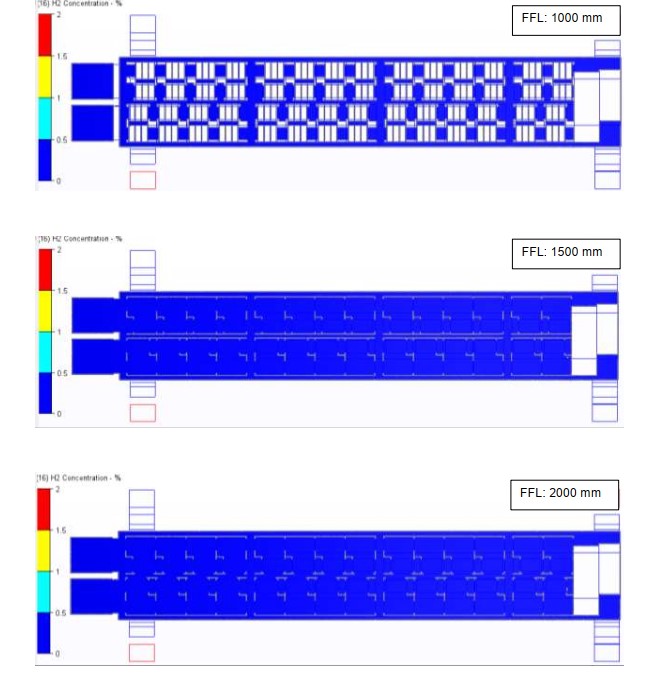
CFD-supported verification of the ventilation concept
The study demonstrated how CFD can support the development of emergency ventilation strategies for high-density battery storage installations.
By examining airflow behavior and gas movement within the actual enclosure geometry, the analysis provided a stronger basis for evaluating the ventilation concept than airflow calculations alone.
The final assessment showed effective circulation through the enclosure and successful removal of the simulated flammable-gas release under the studied operating condition.