

CFD Simulation of Ammonia Dispersion & Emergency Ventilation
A CFD-based assessment of ammonia transport following a simulated refrigerant leak, comparing alternative emergency ventilation strategies and their influence on contaminant movement through a complex industrial space.
Understanding ammonia movement through a complex industrial facility
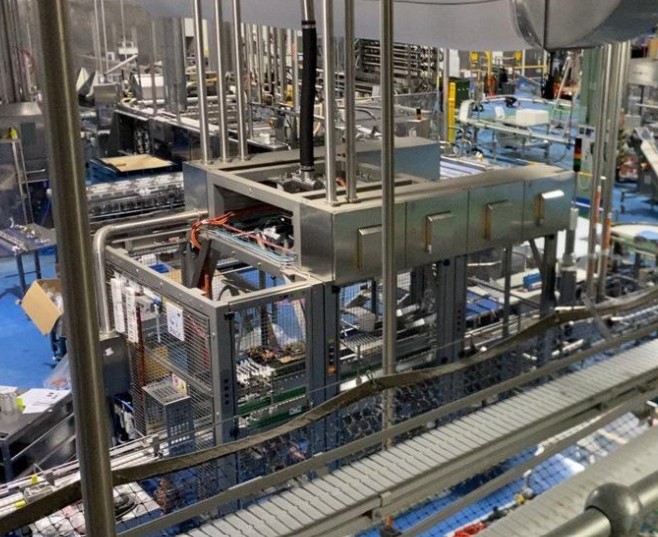
The project involved CFD modelling of an accidental ammonia release within a large industrial refrigeration facility.
The engineering challenge was to understand how the released refrigerant could move through the internal spaces and how different emergency exhaust strategies could influence its transport.
The analysis considered the interaction between the leak source, existing air-handling systems, emergency extraction and the geometry of the occupied facility.
Comparing alternative emergency ventilation strategies
Three ventilation scenarios were simulated to compare the effect of different emergency exhaust configurations on ammonia transport.
The CFD model tracked airflow and contaminant concentration throughout the facility over time, allowing the performance of each strategy to be compared spatially rather than only at a single location.
Air Movement
Streamlines and velocity fields were used to understand the dominant circulation paths throughout the facility.
Ammonia Transport
Concentration fields were tracked over time to show how the release spread through connected spaces.
Ventilation Comparison
Alternative emergency extraction configurations were compared to assess their effect on contaminant movement and removal.
Visualizing contaminant transport across the occupied space
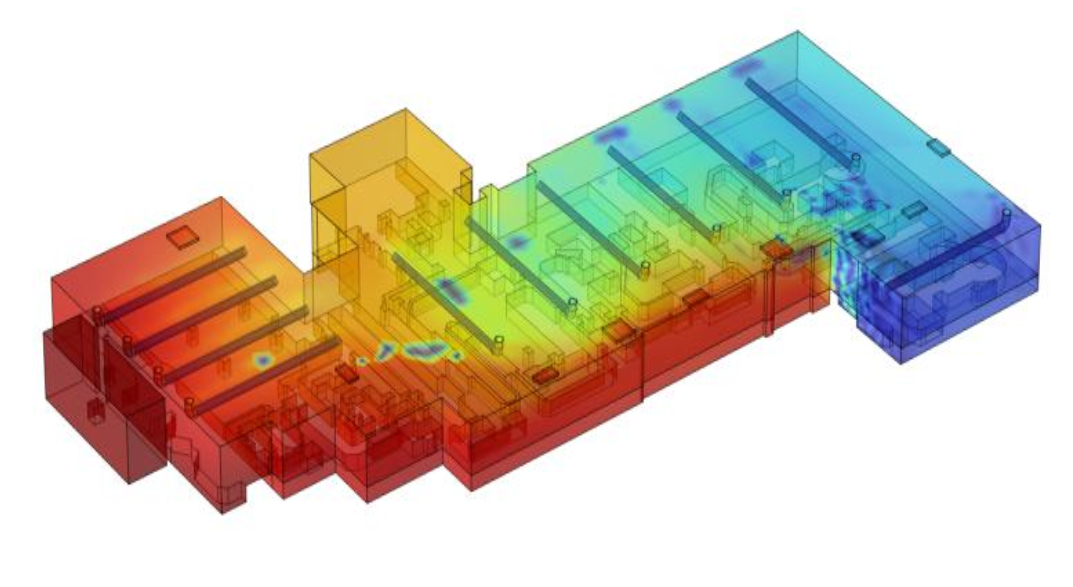
The CFD results showed how ammonia concentration developed throughout the facility over one- and two-hour simulation periods.
Results were also evaluated at representative breathing-zone elevations, providing insight into contaminant exposure patterns at different heights.
Comparing the three ventilation scenarios showed how emergency extraction capacity and location changed the spatial distribution of the released refrigerant.
CFD-supported emergency ventilation assessment
The study provided a detailed spatial view of ammonia transport that could not be obtained from simple ventilation-rate calculations alone.
By comparing multiple emergency ventilation configurations, the analysis showed how exhaust strategy influences contaminant movement throughout a complex industrial facility.
The CFD results provided a technical basis for evaluating emergency ventilation performance and identifying areas where ventilation strategy could be strengthened.