

CFD Assessment of High-Volume Destratification Fan Performance
CFD was used to evaluate how ceiling-mounted high-volume air-movement fans could drive air into the occupied zone of a large high-ceiling enclosure and maintain useful floor-level air movement at different operating speeds.
Moving air effectively through a high-ceiling occupied space
The study evaluated the performance of four ceiling-mounted destratification fans installed above a large indoor enclosure.
The objective was to determine whether the high-level fans could produce meaningful air movement at floor level and throughout the occupied zone without actively cooling the air.
CFD provided a three-dimensional view of the downward jets, floor-level spreading, and interaction between neighboring fan air streams.
Evaluating occupied-zone airflow at multiple fan operating points
Fan performance was assessed at both full and reduced airflow capacity to understand how the resulting air movement changed throughout the enclosure.
Downward Air Jets
CFD evaluated whether the ceiling-mounted jets could maintain sufficient momentum to reach the occupied zone.
Floor-Level Distribution
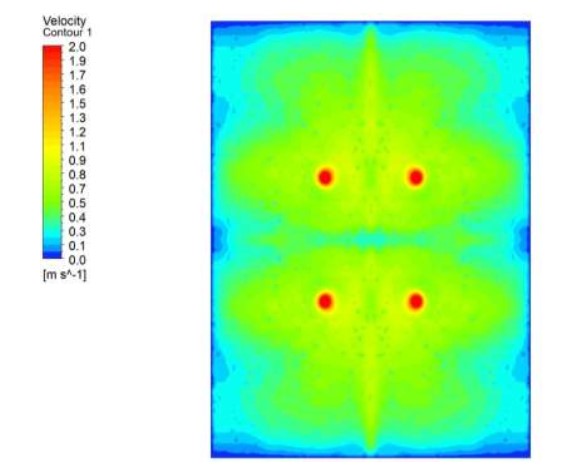
Horizontal velocity fields were assessed near floor level to understand how air spread beyond the direct fan discharge.
Reduced-Speed Operation
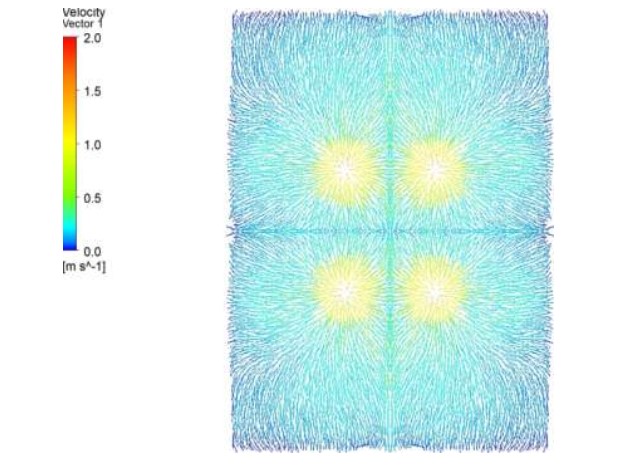
A second operating condition assessed whether useful occupied-zone air movement remained at reduced fan capacity.
Strong downward flow with broad floor-level circulation
At full capacity, the fan jets reached the floor and spread outward across the occupied area. Where neighboring flows interacted, air was redirected upward between the fans.
The same overall circulation pattern remained visible at reduced capacity, although the resulting floor-level velocities were lower.
CFD-supported verification of occupied-zone air movement
The analysis demonstrated that the ceiling-mounted fans could generate substantial downward airflow from high level and distribute that air across the occupied zone.
Useful air movement remained present even at reduced fan capacity, providing insight into how operating speed influences floor-level performance.
The CFD study provided a visual and quantitative basis for evaluating fan layout and operating strategy before relying on full-scale installation testing.